Obtain the skills to analyze and interpret the practices and policies of educational intervention in situations of learning difficulty, in order to intervene in an optimal manner and improve learning processes.
- Home/
- Master's Degree in Psychopedagogy
Master's Degree in Psychopedagogy
Official title
Enrolment open

- ModalityIn-person
- LanguagesCatalan
- DurationTwo years part time (30 ECTS)
- Credits60
- DateOctober 2026
- Planning
1st academic year: Tuesday and Thursday from 5:30 p.m. to 9:30 p.m.
2nd academic year: Monday and Wednesday from 5:30 p.m. to 9:30 p.m.
- Places30
- Location
Blanquerna-URL - Carrer del Císter, 34. 08022 Barcelona
- Faculty
School of Psychology, Education and Sport Science
Who is it for?
Applicants holding the following qualifications are entitled to apply to take the MUP:
Bachelor's degree in Psychology
Bachelor Degree in Education
Bachelor's degree in Primary Education
Bachelor's degree in Early Childhood Education
Bachelor Degree in Social Education
Bachelor Degree in Speech and Language Therapy
The holders of diplomas in Teaching and Social Education and graduates in Psychology and Pedagogy are also eligible
Improve your qualifications
The university master degree in Psychopedagogy (MUP) offers, on the basis of a practical and research-based approach, specialized training for psychopedagogical and guidance service professionals to intervene and advise schools in the different stages of education (early childhood, primary, secondary and post-compulsory education) in order to provide guidance and counseling, with an inclusive approach, on issues related to improving the educational quality of schools, teacher training and innovation, mentorship, attention to diversity, learning difficulties and vocational and professional guidance.
It also allows counseling and psychopedagogical intervention in other areas that require it.
In accordance with the definition of the European Higher Education Area, the goal of master degree courses must be for the student to acquire advanced, specialized or multidisciplinary training, aimed at professional specialization.
In this regard, the Master Degree in Psychopedagogy aims to:
- Train professionals who are competent in the psychopedagogical field in schools and institutions to be able to intervene in guidance on learning processes and their difficulties, in addressing diversity in schools, as well as providing educational guidance.
- Obtain the skills to analyze and interpret the practices and policies of educational intervention in situations of learning difficulty, in order to intervene in an optimal manner and improve learning processes.
- Develop in the MUP students the capacity to foster reflection and innovation in the field of psychopedagogical intervention for the care of infants and young people with learning difficulties and for guidance within the school setting.
- Provide the necessary strategies and work tools to meet the needs of schools and the need for continuing education in educational guidance and innovation, in order to enhance the capabilities of schools, as well as respond to learning difficulties.
Taking into account the need for employability and the approach of the Blanquerna-URL School of Psychology, Education and Sport Sciences, the specific professional competencies for which the students of the Master Degree in Psychopedagogy are trained are as follows:
- Diagnosing and analyzing the educational needs of individuals, groups and educational organizations based on different methodologies, tools and techniques, taking into consideration the singularities of each context in the stages of early childhood and primary education.
- Identifying learning problems and difficulties, and developmental and behavioral disorders in school settings.
- Having the knowledge and tools to advise education professionals regarding the organization, design and implementation of inclusive, quality teaching-learning processes and experiences in the stages of early childhood and primary education.
- Furthering the personal and professional development of those working in the field of education by means of the principles and foundations of psychopedagogical guidance.
- Designing a tutorial action plan based on knowledge of tutorial action methods and techniques.
- Proposing educational practices, programs and services that comprehensively address the educational needs of individuals.
- Formulating proposals for improvement in psychopedagogical intervention based on the results of psychopedagogical research.
- Knowing and analyzing the characteristics, organization and operation of psychopedagogical counseling and guidance services that operate at different levels of the education system. Identifying needs in the educational setting that call for research and improvement activities.
- Having knowledge of research and innovations related to psychopedagogical counseling and guidance and identifying dissemination forums.
- Identifying barriers to and facilitators of inclusive education, both in schools and in other socio-educational settings.
- Performing psychopedagogical assessments and designing support measures for students who require them.
- Acquiring knowledge to guide students in decision-making in the personal, social, academic and professional realms.
- Being aware of mediation techniques for conflict management and improving coexistence in educational settings throughout the different stages of education.
- Acquiring experience in providing psychopedagogical counseling and guidance by applying the knowledge gained during training through a professional model based on reflection.
- Having basic digital tools to apply in the field of psychopedagogical counseling and guidance.
- Becoming familiar with different counseling and psychopedagogical guidance systems in order to develop an approach in line with the specific characteristics of the context where intervention is needed.
- Laying the foundations for psychopedagogical reflection, taking into account the educational setting and its dynamics. Diagnosing and analyzing the educational needs of individuals, groups and educational organizations based on different methodologies, tools and techniques, taking into consideration the singularities of each context in secondary education.
- Having the knowledge and tools to advise education professionals regarding the organization, design and implementation of inclusive, quality teaching-learning processes and experiences in secondary education.
Great scope for professional growth
In accordance with the definition of the European Higher Education Area, the goal of master degree courses must be for the student to acquire advanced, specialized or multidisciplinary training, aimed at professional specialization.
In this regard, the Master Degree in Psychopedagogy aims to train professionals who are competent in the psychopedagogical field in schools and institutions to assess learning processes and their difficulties, address diversity in schools, and provide educational guidance.
In the field of psychopedagogical intervention for the care of infants and young people with learning difficulties and for guidance within the school setting.
The needs of schools and the need for continuing education to deal with educational guidance and innovation, in order to enhance the capabilities of schools and respond to learning difficulties.
If you choose the Blanquerna-URL Master Degree in Psychopedagogy, you are choosing...
A guaranteed future career.
- Certified training: The master degree provides the qualification necessary to work as a specialist in special education*.
- Practical training: Very practical subjects applied to everyday school situations.
- Specialized faculty members: Highly qualified and with extensive educational experience.
- Qualifies the student as a counselor*: The Blanquerna School of Psychology, Education and Sport Science master degree in Psychopedagogy is equivalent to the University Master Degree in Compulsory Secondary Education and Baccalaureate Teacher Training, Vocational Training and Language Teaching, in the specialist field of Counseling.*
* depending on the entry profile
Key data
would repeat the degree again
job placement in 2020, according to EUC
ECTS, divided into 2 academic years
of PhD faculty members
A unique methodology based on personalized learning
According to Royal Decree 1393/2007, graduate studies must provide the student with both basic and sufficient academic training for professional practice and qualify them to continue studying and pursue a master degree. Master degree studies include advanced specialized and multidisciplinary training, the aim of which will be academic and professional specialization or embarking on research activities. Master degrees are required to access PhD studies, which are aimed at providing advanced training in the field of research and lead to preparing a PhD thesis and obtaining a PhD qualification. The master degrees have been adapted to the European Higher Education Area (EHEA) and are structured in ECTS credits (European Credit Transfer System), which make it possible to share a compatible credit system, comparable criteria and methodologies and a duration similar to that of European qualifications, with the aim of facilitating and promoting the mobility and incorporation of students into the European workforce. Master degree studies have a minimum of 60 credits and a maximum of 120 credits. This equates to one to two academic years. ECTS credits are characterized by being student-centered to ensure the student leads their own learning process. Each credit is equivalent to 25 hours of training and is used to count class hours (theoretical and practical), personal study, participation in seminars, assignments, external internships and assessment tests. During an academic year, a student can get a maximum of 60 full-time credits and 30 if they have a part-time job. The master degrees at Blanquerna-URL School of Psychology, Education and Sport Sciences are aimed at diploma and bachelor degree holders and graduates, as well as professionals in need of continuing education. Our master degrees are geared towards professionalization and address subjects and materials that require specialized treatment. Our School's master degrees feature:
Made up of researchers and professors, both from the School and from other universities in the State, and by active professionals of recognized prestige. All teachers are practicing experts in the field of study.
With institutional and business support, coordinated by renowned researchers and professionals.
To guarantee the quality of the teaching, participation and personalized treatment. Agreements and contracts with institutions and companies that guarantee internships or opportunities for professional development and research.
With institutions and companies that guarantee internships or opportunities for professional development and research.


News

May 27, 2024

February 20, 2024

December 4, 2023

July 20, 2023
Academic information
Calendars

Training in line with your interests and future career
Credits
| First | Second | Total | |||||
| Practicum | 14 | 14 | |||||
| Master's degree project | 6 | 6 | |||||
| Compulsory | 30 | 10 | 40 | ||||
| Complements | 12 | 12 | |||||
| Total | 30 | 42 | 72 |
| Subject | Credits | Academic type | |
| First semester | |||
| Psychopedagogical Guidance and Action Framework | 5 | Compulsory | |
| Organization of Psychopedagogical and Guidance Services | 5 | Compulsory | |
| Learning Difficulties, Developmental Disorders, and Attention to Diversity | 5 | Compulsory | |
| Second semester | |||
| Assessment and Psychopedagogical Intervention from an Ecological Model | 5 | Compulsory | |
| The Guidance Department and the Tutorial Action Plan | 5 | Compulsory | |
| Strategies, Instruments and Criteria for Educational Guidance in Compulsory Education | 5 | Compulsory |
| Subject | Credits | Academic type | |
| Third semester | |||
| Psychopedagogical Intervention in the Stages of Early Childhood and Primary Education | 5 | Compulsory | |
| Fourth semester | |||
| Psychopedagogical Guidance and Intervention in Secondary Education | 5 | Compulsory | |
| Annual | |||
| Practicum | 14 | Internships | |
| Master's Final Dissertation | 6 | Master's degree project |
We make it easy for you to access the studies you want
Course fees are paid in installments without any interest. At the time of enrollment, 50% of the total cost of the credits for which the student is enrolled must be paid*; the remaining 50% is split into monthly installments payable by direct debit.
If the University Master's Degree is taken in two academic years, the tuition fee per credit for the second year will be the fee/credit of the first year enrolled in the previous year.
Available discounts for Master’s degrees
*Discounts apply to Official Master’s Degrees, Continuing Education Master’s Degrees, and University-Specific Degrees, and are not cumulative: only one discount may be applied.
Alumni of any degree program associated with a previously paid enrollment. This discount is offered only once per type of degree in which the alumnus/a wishes to enroll.
Companies with which there is a formal collaboration agreement, whether for internships or any other type of partnership model.
Faculty, administrative staff, students, and alumni from university institutions with which there is a study/exchange agreement.
With all professional associations that have a current collaboration agreement. Proof of active membership is required.

Career path
Upon completing the master degree, students can work at public, subsidized or private schools in the fields of counseling, educational psychology and assessment, applying an inclusive approach to addressing diversity, learning difficulties, educational innovation, educational quality, and vocational and professional guidance.


These career opportunities can be pursued in:
- Psychopedagogical offices
- Psychopedagogical guidance departments
- Coordinator in the Department of Psychopedagogical Guidance, Multidisciplinary Services, Pedagogical Resource Centers (CRP)
- Directors, department heads or study coordinators and other positions of responsibility in educational management
- Training and guidance departments
- Psychopedagogical counseling teams
- Development centers and early care
- Others, such as: employment or information and guidance services; educational and social foundations; workplace inclusion support services, etc.

A direct link to your future career
Our work doesn't finish the moment you graduate. The Alumni department will support you to enable us to achieve an employment rate of 90% of students in the first year after graduation
State-of-the-art facilities at students' disposal
The Psychology Laboratory is a space for research into new therapeutic resources. Among other things, it has virtual reality devices applied to psychology that allow for better research.
Music learning is an essential part of education. The School has 3 spaces dedicated exclusively to working in this field: two recording rooms and a dynamic classroom for working on movement and bodily expression.
In this classroom there are individual or group workshops to put into practice the knowledge of the visual and plastic subject. Here you will find various materials for carrying out projects of any format and work in two or three dimensions.

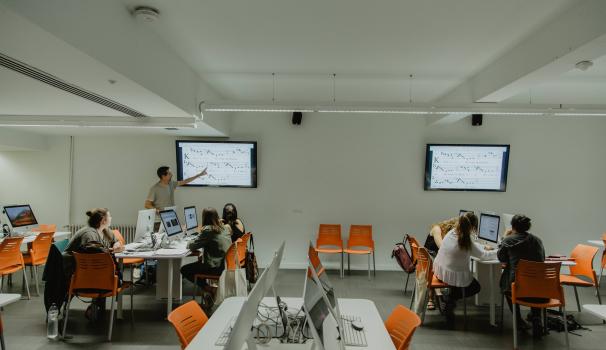
If you have a job or just need a computer, you can go to the computer classrooms or workspaces and use the Macs we have at your disposal.
The Speech Therapy Laboratory is the ideal place to learn the diagnosis of speech and voice disorders or to learn about techniques for dealing with oral and written language problems.

Ethics in the field of research is fundamental. The Faculty Research Institutes are supported by the opinions of the Research Ethics Committees (CER-URL) to evaluate and rate projects that have ethical implications.

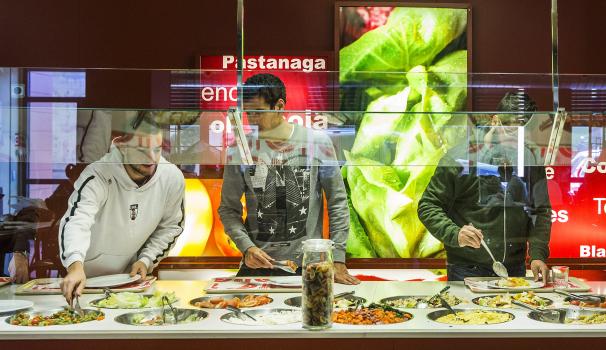
The nerve center of the quintessential faculties is the bar. There, teachers, students and staff meet throughout the day for breaks or meals.
If you need a quiet space to study or to do individual and group work, come to the library! Each school has its own library with computers, workrooms, reading points and an extensive catalog of documents you can consult in both hard copy and digital format.

If you have a job or just need a computer, you can go to the computer classrooms or workspaces and use the Macs we have at your disposal.

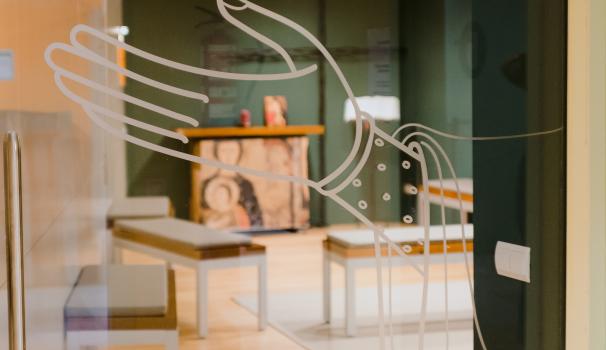
The chapel is the right place to find recollection, peace, to focus, to pray and to celebrate the Eucharist weekly and at important liturgical moments (Christmas, Ash Wednesday and Easter). The sacrament of reconciliation is also celebrated.
All the services you need while you are at the School

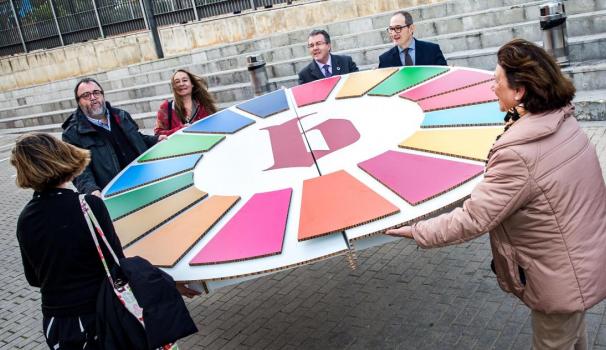
The 2030 Agenda Office of the Blanquerna-URL School of Psychology, Education and Sport Sciences is a project designed to ensure the achievement of the Sustainable Development Goals (SDG) and the milestones set in the Agenda, based on the joint strategies of URL institutions.

The SOPTIC (Pedagogical Guidance Service on Information and Communication Technologies) offers support in the use of ICT to both teachers and other faculty services.

Do you need guidance or support on your research project? The Methodological Advisory Service (SAM) offers you a series of procedures to guide you in your work process in the field of research.

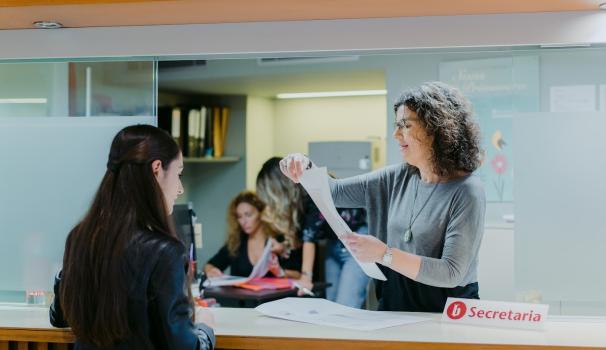
The Academic Secretaries of the Blanquerna faculties are the space for students to relate to the processes linked to the registration of official and own courses.

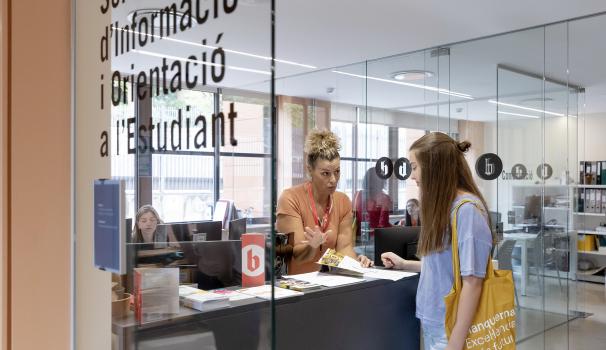
Would you like to receive information on pre-registration and admissions processes, scholarships and grants or validations? The SIOE is the service you need. Ask for all the information about any of these processes and discover all the possibilities at your fingertips.
Professional experience is a core part of our methodology. For this reason, we have a broad spectrum of internship agreements to meet the needs and preferences of all students. You will graduate having worked in your industry.

At Blanquerna, we put the future within everyone's reach thanks to our scholarships and grant service to start or continue studying at our schools. Financial aid is both internal and external to the university. You will find a wide range of possibilities.

Going abroad is a unique opportunity to discover the plurality of the world. Aware of the importance of the internationalization of studies, we have established mobility agreements around the world.

This service provides graduates with the necessary means so that they can actively participate in their professionalism and propose optimal candidates to organizations and companies looking for staff.

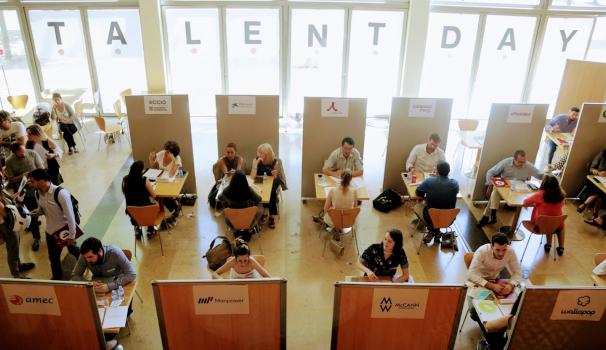
The leap into the world of work is always a challenge. For this reason, we provide a Job Bank for students and graduates. This service puts students in touch with companies and institutions looking for staff.

Solidarity and the struggle for human dignity are values that identify us. Social Commitment is a volunteer program that our students can join to participate in projects in the Third and Fourth World.

Studying in Blanquerna allows you to be part of our community. Being a college student opens the door to a lot of options for continuing your vocational training beyond your time in the classroom.

Want to represent the URL in college sports tournaments? You can find a wide range of possibilities for both individual and team sports. To be a student of Blanquerna, you will have a discount at the Can Caralleu and La Salle Sport & Fitness sports complexes.

If you are in a difficult situation in the academic, personal or social field, you can request, free of charge, the personalized attention of the SOP. This is an interdisciplinary team of professionals who will guide you in dealing with the situation.
In the three Blanquerna faculties, you will find spaces for reflection isolated from the hustle and bustle dedicated to the celebration of the Faith or cultural and religious animation. If you wish, you can also receive personalized attention and information about church life.
At Blanquerna we promote personal development at all levels to people with a diversity of specific needs from a normalizing context that encourages personal autonomy and uniqueness.

If you like music and want to take part in the concerts of institutional events and festivities, sign up for the Blanquerna Choir. There you will meet new friends and enjoy music.

If you play a string instrument (violin, viola, cello, double bass…), a wind instrument (oboe, clarinet, bassoon, French horn, trumpet, trombone, tuba…), or percussion (timpani…), join us! And don’t worry — if you play another instrument (saxophone, drums, flugelhorn…), you’re also welcome to audition!

Each class group must elect a representative to put forward concerns or make proposals to the faculty members and academic management. At the same time, each degree must appoint a delegate and each school a representative on the general URL council.
Contact between students and the university is constant and is channeled through the Student Council, the body that collects proposals and requests from students and facilitates university life.

Are you studying a foreign language and want to improve your level? Do it at your own pace in the language self-learning classroom. This service offers various teaching resources and materials to practice the language.

We’re here to listen! Have you experienced or witnessed any situation of harassment? Do you have any questions about Blanquerna’s equality policy? Would you like to make a proposal or suggestion regarding gender issues? Use this Anti-harassment Point: write to us through the channels you’ll find at the bottom of this page.
Coordinators
Montserrat Alguacil De Nicolás
Ingrid Sala Bars
Faculty
Laura Aguiló Castillo
Clara Andrés Gárriz
Maria Aparisi Marti
Neus Ballesteros Ventura
Natasha Baqués Aguiar
Isabel Beltran Santo
Maria Carme Boqué Torremorell
Cristina Caldas Pérez
Maribel Cano Ortiz
Maria de les Salines Carbó Carreté
Aina Clemares Vallduriola
Núria Colas Migo
David Cosialls Bonet
Maria Francesca Criach Singla
Sandra Carina Fulquez Castro
Victòria García Díaz
Sandra Garrido Romero
Àngels Geis Balagué
Maria Goicoa Ayxendri
Maria del Carmen Hernandez Escolano
Gloria Iniesta Guirao
Gemma Latorre de Dios
Eva Liesa Hernández
Maria Macia Golobardes
Maria Teresa Martínez Guardiola
Sílvia Martínez Perramon
Jaume Miró Cabrero
Olga Muries Cantan
Anna Olivella Mayoralgó
Montserrat Oliveras Bagués
Montserrat Pamias Massana
Miquel Àngel Prats Fernandez
Oscar Puigardeu Aramendia
Natividad Consuelo Ruiz Hidalgo
Maria del Carmen Saez Trancoso
Maria Salgado Voces
Ana Mercedes Sanguinetti Fernandez Ordoñ
David Simó Pinatella
Neus Sole Ferrer
Albert Solé Torné
Marta Vilardell Rodriguez
Application process
University master's degrees are official degrees awarded by the Ministry of Education and Vocational Training, in accordance with the requirements of the European Higher Education Area (EHEA) and the guidelines set out in the Bologna Declaration. To access the official master's degree, you must hold an official Spanish university degree, or a degree from another country that is part of the European Higher Education Area. Access to master's degree studies is regulated by Royal Decree 822/2021, of 28 September.
These studies are also open to students with a degree issued by an education system outside the European Higher Education Area, who do not need to have it approved, provided that the level of training is equivalent to that of an official Spanish degree and that the degree gives access to graduate studies in the country of origin. However, admission does not in any case imply the convalidation of the degree or any other type of recognition beyond allowing the student to access master's and graduate studies at the University.
Phases of the admission process
The admission process for university master's degree studies at the School is developed over three stages:
Application for admission
Admission
Enrollment
Application for admission
The application for admission can be submitted online or in person at the school.
For the online application for admission, the following will be required:
- Sign up on the unique registration system and create a username (if not previously obtained) and follow the instructions to completion.
- Make a payment of €50 (non-refundable fee for application for admission rights and processing) can be made by credit or debit card, through a secure and confidential BBVA process. Alumni are exempt from payment.
- Upload the required documentation through the document repository:
- ID card (both sides), passport or NIE residence card
- Resume
- In some courses, other documents must be attached if the page on each degree indicates as such.
Admission
When application for admission has been completed, the candidate will be offered a date for an interview with the coordinators of the degree, who will assess their suitability and resolve any doubts they may have about the course for which they are enrolling. Motivation, academic transcript and professional experience will be taken into account for the selection of students. Once the assessment is complete, the student will be informed of the result of admission and the enrollment procedure, where applicable
Prior to enrollment, the person concerned must upload the abovementioned documentation to the document repository:
- Qualification or receipt of the qualification of the studies that give the student access to the master's degree.
- Original official academic certificate or certified copy of the bachelor's degree transcript.
- For foreign applicants: certificate issued by the relevant body (university, embassy, consulate) confirming that the studies qualify the student to undertake master degree or graduate studies in the country of issue.
Enrollment
Enrollment formalization is the final procedure to obtain a place in the master's degree:
- The date of enrollment formalization is communicated individually to the person concerned and can be done online.
- After this, they have two business days to pay 50% of the total cost of the credits for which they have enrolled, by bank transfer or using a barcode at the bank; the remaining 50% is split into nine monthly installments, from October to June, payable by direct debit using the bank account indicated at the time of enrollment (Instructions for sending the signed SEPA document to Blanquerna).
Alumni of official qualifications from the School are given a 15% discount on the enrollment fee (non-cumulative discount) if they enroll full time and for all the credits that the qualification offers. Prices are updated each academic year. Once enrollment is complete, the amount paid will not be refunded under any circumstances.
Students who are admitted can choose between two forms of enrollment, depending on whether they already qualify for university admission:
Advanced conditional enrollment: This allows students who meet the following requirements before July 15, 2026 (pending confirmation) to bring forward their enrollment:
- Have submitted the documentation described in the place application section.
- Be in a position to meet the requirements for conditional enrollment (see next section) before the end date of the regular place application period.
- Have completed the interview and received admission from the Master's Degree coordination team.
- Conditional enrollment: Students who have not yet obtained a bachelor's degree and who require a maximum of 9 more credits and/or the thesis yet to do can apply for this. For conditional enrollment, the student must be enrolled for the outstanding credits for their bachelor's degree.
Unless the student has passed the bachelor's degree giving them access, they will not be able to defend the thesis and, therefore, will not be able to obtain the master's degree.
To be eligible for this option, the person concerned must sign this information document in which they agree to the particularities of conditional enrollment. - Final enrollment: Final enrollment is when the person concerned has completed the admission pathway for the university master's degree.
When a student enrolls, a contract for the provision of teaching services is formalized between the student and the Blanquerna Foundation, which is legally binding from the time of payment. Payment includes the corresponding insurance and, for students under the age of twenty-eight, compulsory academic insurance. If a student declines to take up a place, he/she will lose in full any amount he/she has paid.
The student accepts the rules for the use of computer services established by the Blanquerna Foundation. The student's personal data will be included in an automated file under the responsibility of the Blanquerna Foundation, so that this contract can be formalized and fulfilled. Students should note that their data may also be used to inform them about the future activities of the Foundation, or for the institution to send them publications.
In accordance with the provisions of Organic Law 15/1999 on the protection of personal data, students have the right to access their data to update, rectify or cancel them, or object to their use, by sending a letter, indicating which right they want to exercise.
This section is a summary of the general conditions for enrollment. It is only for guidance and therefore has no contractual value. In the event of any discrepancy, the provisions of the general conditions for enrollment specified in the receipt generated at the time of enrollment will prevail; this receipt formalizes the contract between the student and the Blanquerna Foundation; students can consult it on the intranet whenever they wish.
The School cannot guarantee that a course will be available if the requirement for a minimum number of enrollments is not met. In this case, the amount paid for enrollment and pre-enrollment will be refunded in full.
Foreign students
The School reserves the right to ask candidates with qualifications outside the EES for a letter from their university, embassy or consulate to certify that their studies enable them to pursue a master's degree or graduate studies.
Students are responsible for having all the official documentation necessary for their stay in Spain while studying at the School. Applicants can ask for a pre-acceptance document attached to the pre-enrollment receipt to initiate applications for visas or scholarships or carry out any other administrative procedure. Under no circumstances does this document guarantee a place if all the access and admission requirements are not met. Once applicants have been accepted and enrollment is complete, they can request a letter of admission from the Academic Secretary, if required (they will have to pay the corresponding fees).
Contact us
For any doubts or queries about the pre-enrollment or enrollment process, please contact the School's Student Information and Orientation Service:
[email protected]
Master's Degree Thesis
Students must submit a master degree research or intervention project that will be supervised by a doctoral professor attached to the master degree program. A total of 6 ECTS is allocated to this project (equivalent to about 48 hours of group sessions plus additional individual sessions).
This project will be publicly defended before a panel made up of doctoral professors from the master program. In the case of the research track, the members of the panel must be accredited by ANECA, the AQU or an equivalent agency. It is recommended that one of the members of the panel be from outside the master degree course, but they should be a member of a graduate studies program at the Blanquerna-URL School of Psychology, Education and Sport Sciences.
Students must submit a master degree research or intervention project that will be supervised by a doctoral professor attached to the master degree program.
The master degree thesis may be written up in Catalan, Spanish, or English.

A total of 6 ECTS is allocated to this project (equivalent to about 48 hours of group sessions plus additional individual sessions).
The assessment criteria for the master's degree thesis are concerned with the competences consolidated during the preparation process, the final product and the defense of the thesis itself. The final grade will thus be the result of various partial evaluations:
- The skills consolidated during the preparation process (15 %): grades will be given for persistence and consistency in the different stages of the project preparation, and progression in the acquisition of the skills and attitudes necessary for the research and intervention. This assessment will be performed by the project advisor and the students themselves (self-assessment).
- Article (60 %): the various aspects taken into account in most scientific publications will be assessed to ensure the consistency and quality of the research or intervention.
- Skills achieved in the oral defense of the thesis (25 %): the clarity, accuracy, originality and quality of the oral presentation of the project will be assessed according to the requirements of presentation before a panel.
Scholarships and grants Blanquerna
Objectives of the internship
- External internships are worth 14 ECTS and will be carried out during the academic year at public, subsidized or private centers: EAPs, CPRs, CDIAPs, guidance teams, psychopedagogical offices, among others. These centers must have a training project for internship students.
- The curriculum of the University Master Degree in Psychopedagogy attributes a central role in training students to the internship; for this reason it is the module with the most credits. The internship period will be divided into three stages:
- Observation
- Period of supervised work
- Independent work practice
The following are taken into account for the purposes of assessing the internship:
- Student self-assessment
- Assessment by the university advisor
- Assessment by the tutor in the center
The internship is an opportunity to put into practice the learning acquired in the other subjects of the master degree. Internships provide relevant contact with career reality and are therefore an important source of professional and personal enrichment.
They also develop the critical and self-critical capacity necessary to formulate questions, and thus become an essential driving force for scientific research and for academic and professional development as a whole.
MUP students are required to do internships at an institution involved in psycho-pedagogical projects and training and educational guidance, for a total of 280 hours of external practical experience, plus 70 hours within the School Seminar, under the guidance of an MUP professor with individualized support and follow-up.
The internships are carried out in institutions with which the Blanquerna-URL School of Psychology, Education and Sports Sciences has an internship agreement. These are public, subsidized and private centers.
Where can you do your internship?
CREIX Barcelona EAP B-01 Nou Barris (Barcelona) · Escola Sadako (Barcelona) · Escola Pia Sabadell (Sabadell) · Centre Bruguer-Merello Psicopedagògic (Barcelona) · Escola Garbí (Esplugues) · Escola Garbí-Pere Vergés (Badalona) · Institut d'Educació Secundària Miquel Biada (IME) (Mataró) · Espai de Psicomotricitat i Teràpia Familiar (Sant Cugat del Vallès) · Espai de Psicomotricitat i Teràpia Familiar (Barcelona) · EAP B-34 Sabadell (Sabadell) · Institut- Escola Costa i Llobera (Barcelona) · Escola IPSI (Barcelona) · Escola Virolai Taktikum (Barcelona) · Col·legi Maristes La Immaculada (Barcelona) · Educaweb (Barcelona) · Institut Barri Besòs (Barcelona) · EAP B-02 Sant Andreu (Barcelona) · L'Enllaç. Espai Terapèutic (Barcelona) · Servei d'Assessorament i Intervenció Psicopedagògica (SAIP). Blanquerna-URL School of Psychology, Education and Sport Sciences (Barcelona) · CREDAC Pere Barnils (Barcelona) · Grup Cercles (Vilanova del Vallès) · Centre Empatia (Mataró) · Escola El Cim (Vilanova) · Institut d'Educació Secundària Torre Roja (Viladecans) · Escola Singuerlín (Santa Coloma de Gramenet)
In addition, students can look for other centers engaged in guidance and psychopedagogical activities to do their internship.
Master's degree accredited by the AQU (Quality Assurance Agency)
Gender perspective
As the European Union points out, gender equality is not only a matter of social justice but also affects the results of teaching and research. Promoting gender equality in research and innovation is one of the European Commission's commitments, and it supports the explicit integration of a gender perspective in Horizon 2020 projects. However, this recommendation is often poorly understood and misapplied. Various documents are presented here with a view to contributing to a better understanding and application of the gender perspective in teaching and research.

RELATED PROGRAMS