- Home/
- Certificate of Advanced Studies in Grief Counseling*
Certificate of Advanced Studies in Grief Counseling*
Enrolment open

- ModalityHybrid learning format
- LanguagesCatalan, Spanish
- Duration1 academic year
- Credits25
- Location
Campus Salut Blanquerna-URL (Padilla, 326 i Travessera de Gràcia, 401)
- Faculty
Blanquerna School of Health Sciences
Introduction
Specialize in grief counseling with an innovative program that integrates scientific knowledge, a humanistic perspective, and practical tools applicable to clinical, social, and community contexts.
You will learn to understand grief processes, develop communication and counseling skills, identify risk situations, and intervene using an ethical, respectful, and person-centered practice.
*This program is pending approval
Who is it for?
The Certificate of Advanced Studies in Grief Counseling is aimed at professionals in the healthcare and social fields who wish to deepen their understanding of counseling people going through loss and grief from an integral, humanistic, and evidence-based perspective.
Especially designed for professionals in nursing, medicine, psychology, physiotherapy, social work, social education, speech and language therapy, nutrition, and other disciplines related to human care and attention.
Improve your qualifications
This program was created to train professionals in grief counseling from an integral, humanistic perspective based on scientific knowledge. The general objectives are:
- Deepen understanding of the conceptual foundations of grief and its psychological mechanisms.
- Identify and understand the various ways of experiencing grief in an adaptive manner.
- Develop specific communication skills to counsel people going through the grief process.
- Identify the variations of grief in order to apply them to counseling in specific contexts.
- Integrate the spiritual and existential dimension into counseling, validating and supporting subjective experiences.
- Provide participants with practical tools for grief counseling in professional and community contexts.
- Analyze the specific needs of each type of grief and adapt the intervention accordingly.
- Promote a healthy, ethical, and mindful professional practice.
- Apply knowledge in simulated situations and demonstrate professional competencies.
- Develop a grief micro-project reflecting a specific theme within grief counseling.
- Empathic and therapeutic communication in contexts of loss.
- Critical thinking and professional reflection regarding the phenomenon of grief.
- Ethical, respectful, and person-centered professional practice.
- Emotional management and self-care in healthcare practice.
- Application of theoretical knowledge to practical situations.
- Ability to design and develop short intervention projects.
- Understanding of the conceptual and psychological foundations of grief.
- Identification of adaptive responses and variations of grief according to context.
- Assessment of needs and adaptation of counseling to each type of grief.
- Development of specific skills in grief counseling.
- Integration of the spiritual and existential dimension in a respectful and secular manner.
- Application of knowledge in simulated situations with professional judgment.
- Design of a micro-project related to grief counseling.
Why should I choose this Certificate of Advanced Studies?
Because the course combines academic rigor, clinical experience, and experiential spaces to transform your professional practice. You will learn to counsel grief processes from an integral, human, and evidence-based perspective, acquiring useful tools applicable from day one. In addition, you will learn from a leading faculty in the fields of grief, palliative care, and emotional support. A program designed not only to expand knowledge, but also to grow personally and professionally.

Curriculum
- Loss as a universal human experience
- Basic concepts: loss, grief, death, and life transitions
- Death, grief, and meaning: anthropological and cultural perspective
- Neurobiological bases of grief
- Emotional, cognitive, and bodily responses
- Grief and health: impact on physical and mental health
- Cultural and social factors in the expression of pain
- Risk and protective factors
- Models of grief and meaning-making
- Classic and contemporary models: Worden, Neimeyer, Stroebe & Schut
- Grief as a narrative reconstruction
- Types of grief and differential processes
- Anticipatory grief and traumatic grief: key concepts and approach
- Other forms of grief (ambiguity, social recognition)
- Adaptive grief and complicated grief
- Grief in contexts of illness and anticipatory processes
- Working with progressive losses
- Ambivalence, attachment, and preparation for loss
- Counseling contexts
- Family, social, and school systems
- Couples and grief
- Rituals and critical moments
- Christmas and holidays
- Rituals and symbolic practices from a narrative perspective
- Grief, spirituality, and transcendence
- Spiritual dimension of grief and the search for meaning
- Rituals, beliefs, and cultural practices associated with loss
- Complementary perspectives
- Systemic approach
- Counseling in the work and subjective perception of symbolic experiences
- Helping relationship and therapeutic presence
- Active listening, validation, and boundaries
- Counseling in grief (basic level)
- Intervention techniques
- Common mistakes in counseling
- 10 TIPS tool in the grief process
- Mutual Support Groups (GAM) and Therapeutic Groups
- Emotional support and psychoeducation techniques
- Meaning-making
- New rituals, significant dates
- Continuing bonds
- Basic concepts in the approach to suicide attempts
- Creative tools
- Therapeutic writing
- Creation of graphic materials
- Lifeline work
- Art therapy; experiential introduction
- Therapeutic dance work session oriented toward grief counseling
- Resource library
- Stories that help; workshop on the application of therapeutic stories in grief processes
- Critical analysis session on representations of grief in literature and cinema
- Community, mental health, and social support resources
- Skills and attitudes of the counselor
- Self-knowledge of the counselor and the impact of their own unresolved griefs
- Centering tools for the professional
- Meditation and emotional self-regulation workshop
- Self-care and professional boundaries
- Ethics and reflective practice in grief care
- Grief over the death of a partner; key concepts, particularities, specific approach
- Grief over the death of a child; key concepts, particularities, specific approach
- Perinatal grief; key concepts, particularities, specific approach
- Migratory grief; key concepts, particularities, specific approach
- Professional grief; key concepts, particularities, specific approach
- Grief due to death by suicide; key concepts, particularities, specific approach
- Grief over the death of a pet; key concepts, particularities, specific approach
- Case simulations
Easy terms for you to access the course
2026-2027 Academic Year
Application for a place: €50 in pre-enrollment fees. If you are not admitted or the graduate studies program is canceled by the Blanquerna School of Health Sciences, the amount will be refunded during the academic year in which you pre-enrolled, upon presentation of the corresponding receipt.
Tuition fee per credit
€111.65
Total tuition for the course
€2,791.25
Payment method
Fees are payable in three installments:
- Initial payment: 34% at the time of enrollment.
- January: 33%
- March: 33%
Discounts available for master’s and postgraduate studies
*Discounts apply to official master’s degrees, lifelong learning master’s programs, and proprietary degrees, and are not cumulative: only one discount can be applied.
15% - Blanquerna Alumni
Blanquerna alumni from any study program associated with a previous paid enrollment. Offered only once for each different type of qualification in which the alumnus/a wishes to enroll.
10 to 15% – Institutions and Partner Companies
Companies with which there is a formal collaboration agreement.
10% – Professional Associations
With all professional associations that have a valid collaboration agreement in place. Proof of membership is required.
10% – University Institutions
Faculty, administrative staff, students, and alumni of university institutions with which there is a study/exchange agreement.

Career opportunities
This program qualifies professionals in the healthcare, social, and educational fields to counsel grief processes from an integral, human, and evidence-based perspective. The program allows students to acquire specific competencies applicable in various healthcare and community contexts.
The main career opportunities are:
- Counseling of individuals and families going through loss and grief processes.
- Intervention in healthcare, sociosanitary, and community contexts.
- Emotional support in hospital units, palliative care, and home care.
- Participation in support groups and therapeutic spaces related to grief.
- Development of projects and initiatives related to emotional counseling and the humanization of care.
- Application of communication and emotional management tools in daily professional practice.
- Improvement of professional competencies in comprehensive care for people experiencing loss.
State-of-the-art facilities at the students’ disposal
Theoretical-practical classrooms and clinical simulation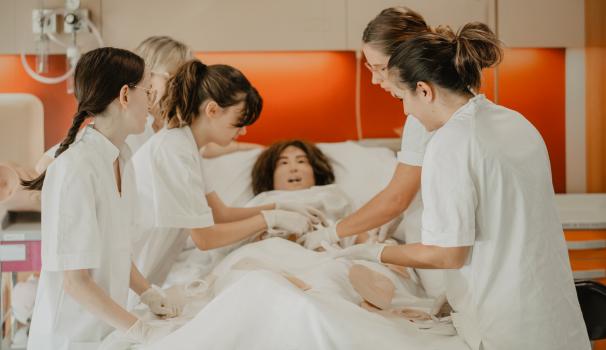
Theoretical-practical classrooms and clinical simulation
Putting theory into practice is key to gaining knowledge. In the case of nursing, it is a key aspect before dealing with patients. The faculty has simulation classrooms to prepare students for clinical interventions.
Anatomy room. Osteoteca
Anatomy room. Osteoteca
This room has teaching resources so that students can become familiar with the human body, identify and locate muscles, bones, arteries, veins or nerves.
Anatomy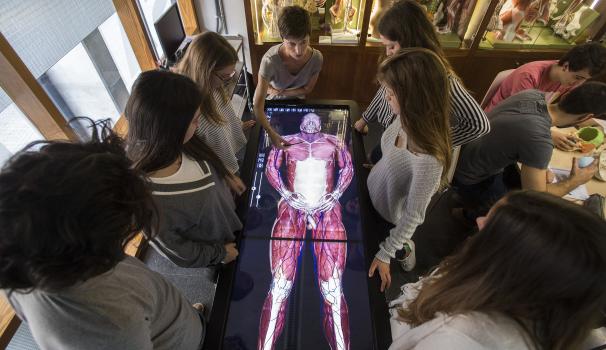
Anatomy
See human anatomy in its entirety on a real scale and in 3D. This is the reality that allows the anatomy, an interactive display table to see any anatomical system of the human body.
Libraries
Libraries
If you need a quiet space to study or to do individual and group work, come to the library! Each school has its own library with computers, workrooms, reading points and an extensive catalog of documents you can consult in both hard copy and digital format.
Computer rooms
Computer rooms
If you have a job or just need a computer, you can go to the computer classrooms or workspaces and use the Macs we have at your disposal.
Chapel
Chapel
The chapel is the right place to find recollection, peace, to focus, to pray and to celebrate the Eucharist weekly and at important liturgical moments (Christmas, Ash Wednesday and Easter). The sacrament of reconciliation is also celebrated.
All the services you need while you are at the School
Libraries
Libraries
If you need a quiet space to study or to do individual and group work, come to the library! Each school has its own library with computers, workrooms, reading points and an extensive catalog of documents you can consult in both hard copy and digital format.
Computer rooms
Computer rooms
If you have a job or just need a computer, you can go to the computer classrooms or workspaces and use the Macs we have at your disposal.
Chapel
Chapel
The chapel is the right place to find recollection, peace, to focus, to pray and to celebrate the Eucharist weekly and at important liturgical moments (Christmas, Ash Wednesday and Easter). The sacrament of reconciliation is also celebrated.
Faculty
Directors: Dr. Montserrat Esquerda and Ms. Marta Palomares
- Carla Cusó Cuquerella. Nurse specialized in pediatric palliative care, neonatal and pediatric intensive care, and counseling in grief processes. Grief therapist at Vall d’Hebron University Hospital and facilitator of interdisciplinary reflection groups at Mémora.
- Clara Gomis. PhD in Philosophy and Letters and associate professor at Blanquerna-URL.
- Claudia Alonso Granados. Nurse specialist in pediatrics. Grief therapist at Sant Joan de Déu Hospital Esplugues, with experience in counseling through loss, grief, and crisis processes, as well as in pediatric and school care.
- Cristina Olivé. Diploma in Nursing and professor at Blanquerna-URL.
- Francesc Torralba. PhD in Philosophy, full professor, and professor at Blanquerna-URL.
- Jordi Sánchez. PhD in Anthropology and professor at Blanquerna-URL.
- Marta Palomares Delgado. Nurse specialist in pediatrics. Nursing coordinator and grief therapist in the Palliative Care and Complex Chronic Patient Service at Sant Joan de Déu Hospital Esplugues and member of the healthcare ethics committee at HSJD Esplugues. Specialized in loss, grief, and crisis, as well as in nursing care in childhood and adolescence and complementary therapies.
- Montserrat Esquerda Aresté. Bachelor’s degree in Medicine and Psychology, PhD in Medicine, and Master’s in Bioethics and Law. Coordinator of the complex grief unit for children and adolescents at SJD Terres de Lleida and dean of the Blanquerna School of Health Sciences.
- Nuria Carsi Costas. Nurse and grief therapist at Sant Joan de Déu Hospital Esplugues. Clinical consultant nurse at AFANOC, with experience in emotional counseling and care for children and families.
- Nuria Colás. Diploma in Nursing and professor at Blanquerna-URL.
- Olga Herrero. PhD in Psychology and tenured professor at Blanquerna-URL.
- Pau Miquel Diego. Nurse and psychologist. Coordinator and spiritual care provider of the Spiritual and Religious Care Service at Sant Joan de Déu Hospital Esplugues. Specialized in humanization, spirituality, and psychoanalytic psychotherapy.
- Sergi Corbella. PhD in Psychology and tenured professor at Blanquerna-URL.
Application process
To access the master degree and/or university specialization diplomas, you must hold an official Spanish university degree, or a degree from another country in the European Higher Education Area. These studies are also open to students with a degree issued by an education system outside the European Higher Education Area, who do not need to have it approved, provided that the level of training is equivalent to that of an official Spanish degree and that, in the country of origin, the degree gives access to graduate studies. However, admission does not in any case imply the convalidation of the degree or any other type of recognition beyond allowing the student to access master and graduate studies at the University.
Furthermore, these courses are open to people who do not have a degree but who, due to their professional or personal background, are considered qualified to take them. In these cases, the degree they will obtain will be a university extension.
The application process consists of two parts:
Pre-enrollment
Enrollment
Pre-enrollment
Students can pre-enroll online (by accessing Pre-enrollment | Blanquerna or the pre-enrollment option for each course). It can also be done in person at the School.
During the process, the candidate must submit the requested documentation:
- ID card, passport or NIE residence card.
- Certified photocopy of the qualification that gives the student access to the course or documentary proof that the relevant document has been requested.
- Copy of the official academic transcript with grades for the courses taken and the average mark of the qualification justifying admission.
- Students with studies qualifying them for access completed outside Spain: certificate issued by the relevant body (university, embassy, consulate) confirming that the studies qualify the student to undertake master degree or graduate studies in the country of issue. Students who come from a foreign university must provide details of the grading system used at their university, as well as the aforementioned documentation, which must comply with the requirements for translation and legalization established in current regulations.
- Payment of €50 in terms of pre-registration fee. The amount of the application will only be returned in case of cancellation of the course by the center. The amount will be returned during the course in which pre-registration has been made, upon presentation of the corresponding receipt. Payment is by credit or debit card using a secure and confidential process.
Once pre-enrollment is complete, the documentation will be assessed, and the student will be informed of the result and how to enroll, if applicable.
Enrollment
Enrollment is the final step in the procedure to access the master degree or graduate studies. Each student will be informed in the letter of admission of his/her enrollment date. When enrollment is complete, with payment of the corresponding fee, the student will have definitively secured a place. If the student leaves the course, the enrollment fee will not be refunded in any case. The School reserves the right to cancel any courses for which the required minimum number of enrolled students has not been reached. In this case, the amount paid for enrollment will be refunded in full.
Documentation to be provided:
- Certified photocopy of the degree certificate or certified photocopy of the university studies completed.
- Official academic certification (list of subjects studied with their grade).
- Current account number for direct debit in case of payment by installments.
When students enroll, they will have two business days to pay the total cost of enrollment, by bank transfer, credit card or barcode. Studies can be paid in full or in installments, without any interest, by bank transfer.
If payment by installment is selected, students will have two business days following completion of enrollment to pay 33.3% of the total cost of the enrolled credits, using their chosen form of payment; this payment cannot be made by direct debit. The remaining 66.4% is split into two monthly installments, in January and March, payable by direct debit using the bank account number provided upon enrollment.
School alumni are given a 15% discount on the enrollment fee (non-cumulative discount). Distinctions obtained in the fourth academic year of the bachelor degree are not eligible for a discount in own master degrees and graduate studies. Prices are updated each academic year. Once enrollment is complete, the amount paid will not be refunded under any circumstances.
When a student enrolls, a contract for the provision of teaching services is formalized between the student and the Blanquerna Foundation, which is legally binding from the time of payment. Payment includes the corresponding insurance and, for students under the age of twenty-eight, compulsory academic insurance. If a student declines to take up a place, he/she will lose in full any amount he/she has paid.
The student accepts the rules for the use of computer services established by the Blanquerna Foundation. The student's personal data will be included in an automated file under the responsibility of the Blanquerna Foundation, so that this contract can be maintained and fulfilled. Students should note that their data may also be used to inform them about the future activities of the Foundation, or for the institution to send them publications.
In accordance with the provisions of Organic Law 15/1999 on the protection of personal data, students have the right to access their data to update, rectify or cancel them, or object to their use, by sending a letter, indicating which right they want to exercise.
This section is a summary of the general conditions for enrollment. It is only for guidance and therefore has no contractual value. In the event of any discrepancy, the provisions of the general conditions for enrollment specified in the receipt generated at the time of enrollment will prevail; this receipt formalizes the contract between the student and the Blanquerna Foundation; students can consult it on the intranet whenever they wish.
Foreign students
The School reserves the right to ask candidates with qualifications outside the EES for a letter from their university, embassy or consulate to certify that their studies enable them to pursue a master degree or graduate studies.
Students are responsible for having all the official documentation necessary for their stay in Spain while studying at the School. Applicants can ask for a pre-acceptance document attached to the pre-enrollment receipt to initiate applications for visas or scholarships or carry out any other administrative procedure. Under no circumstances does this document guarantee a place if all the access and admission requirements are not met. Once applicants have been accepted and enrollment is complete, they can request a letter of admission from the Academic Secretary, if required, by paying the corresponding fees.
Contact us
For more information, please contact the prospective students department.
[email protected]
To be admitted to the Certificate of Advanced Studies in Grief Counseling, applicants must hold a diploma or a bachelor’s degree in Nursing, Medicine, Physiotherapy, Psychology, Human Nutrition and Dietetics, Pharmacy, Speech and Language Therapy, and/or Social Education.
Candidates who meet the requirements specified in current URL legislation and regulations may also be admitted to the program. Admission is not available to candidates without a university degree.
Scholarships and grants Blanquerna
RELATED PROGRAMS